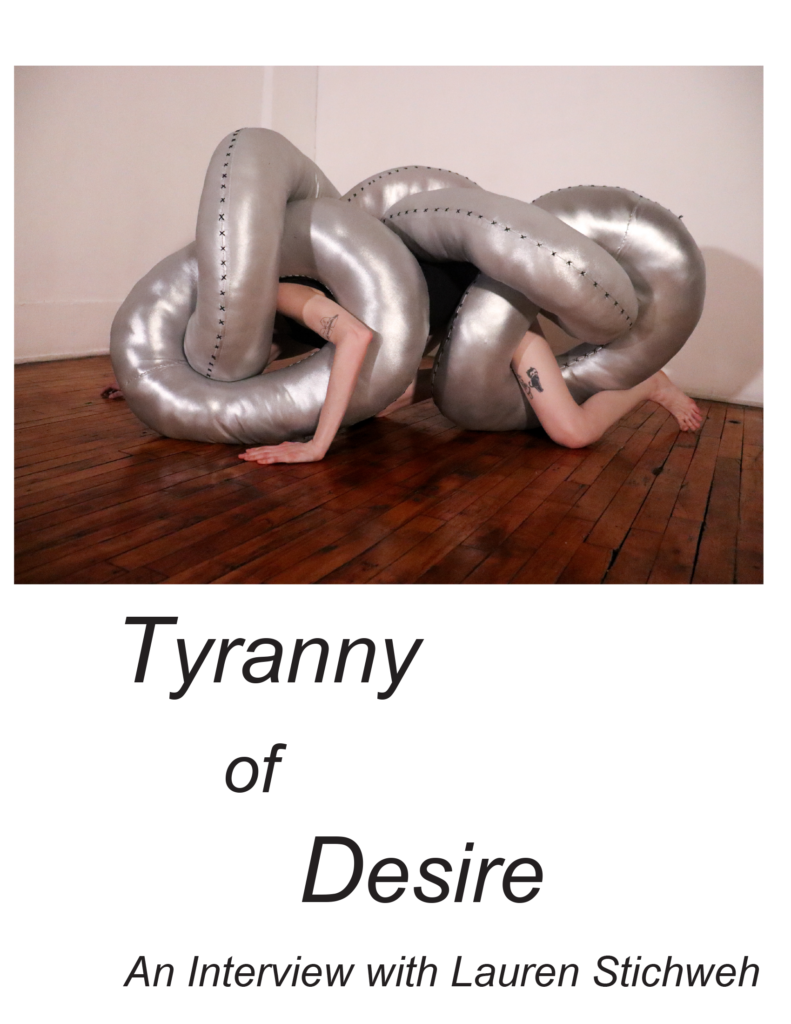
Photo: Zoe De La Paz
Interview transcript from March 21, 2026
Lauren Stichweh (LS) interviewed by Mark Banks (MB).
MB: Okay folks, this is Mark Banks, thanks for tuning in to our inaugural issue of Remainder. I’m here now doing our very first artist interview. Our first-ever guest is a final-year graduate student at the School of the Art Institute of Chicago, Lauren Stichweh, here to talk about her practice and her recent and upcoming projects. Lauren is an interdisciplinary artist working in fiber, sculpture, and performance. Lauren, would you please introduce yourself and give us a quick elevator pitch about your practice?
LS: Hi, I’m Lauren Stichweh. Like you said, I work in fiber, sculpture and performance. I’d say my practice centers around investigating the entanglements between intimacy, labor, and power, through those mediums.
MB: Very cool. And where are you from?
LS: Georgia. I grew up an hour north of Atlanta and spent five or six years in Athens after that.
MB: And where did you do your undergraduate studies?
LS: The University of Georgia.
MB: Okay, great. Uhm, the last time I visited your studio, we talked a little bit about a performance you had coming up. That performance has since been activated, at a reception this past Valentine’s Day at GAG, the Garden Apartment Gallery, here in Chicago. How did that performance go? Tell us about it.
LS: That was great. The show was called Holy Mother, Call Me!, curated by Jessie Devereaux, a friend of one of my advisors, Kirin Wachter-Grene. It was great to meet Jessie and get connected to the event. The piece that I activated was called Optimism is a Cruel Mistress, I Cannot Escape Her Touch. It’s a reiterative performance that I’ve been working on for about a year. For the piece, I’ve made this soft-sculpture chain that’s maybe about eight feet long, longer than my body, out of metallic spandex filled with pillow stuffing. In the performance element of this piece, I interact with the sculpture and activate it by physically inserting and entangling myself through links of the chain and, sort of like, crawling around and rolling around on the floor. The time-lengths of the performance iterations vary, but this one at GAG was around 30 minutes.
MB: Very cool. And I want to just give readers a detailed description of what I’m seeing here, there is a pile of giant plush chain-links, like the sizes of small inner tubes you might see at a waterpark, linked together. And there are what, about five or six connected links?
LS: Five links.
MB: And they look heavy, right?
LS: Yeah I think they’re each about five pounds.. Or wait, no, it’s gotta be more than that. I think the whole thing put together is closer to around 35 or 40 pounds.
MB: Wow, so you’ve got this heavy 35 or 40 pound, 8-foot long, mobile and fluid sculpture that you crawl into and sort of get stuck within as you try to move the pieces and yourself around from the inside, for extended periods of time. I know we talked in a previous conversation about the question of duration. That seems very significant here.
LS: That’s right. I’m really interested in the endurance element. Like I said, it’s been a multi-iterative piece, so I’ve done it for varying time-lengths from 15 minutes to an hour. My ultimate goal is to get it up to several hours, to the point that I’m fully exhausting myself through this interaction, and the movement of my intertwined body is more so dictated by this sculpture itself than it is by my own agency.
MB: That very interesting. At the other end of the activation timeline, how does each iteration of a piece like this begin?
LS: (laughter) That’s kind of one of the hardest parts about it for me…uhm…it’s one of those things that I haven’t had a the chance or time or opportunity yet to fully idealize, or to realize in my fully idealized version. So like, everytime I’ve done it, I’m sort of just like God, I don’t want it to start and I don’t want it to stop. I want, you know, these things to be very natural. So I’ve done different things to start. For the GAG performance specifically, there were two rooms in the gallery, so Jessie and I talked and kind of made a plan before the show to gather the audience in one room while I got ready in the other room with the sculpture and came out of the doorway.
MB: So you sort of just crawled in, already entangled?
LS: Yes.
MB: And so, each iteration is different, not only in terms of how you start and finish, but I also noticed in the video from GAG that this time there was another performer involved. This was a sort of new addition to this piece, right?
LS: Yeah, so Elizabeth Schmul was the name of the other performer, she’s a friend of Jessie Deveraux’s, from Detroit. The event was set up as a night of performances, and Elizabeth was there to do a piece too. She’s a choreographer and she had this performance ready, but when we were all talking about how we wanted to structure the night, we ended up deciding that it would be really cool to just see both of our performances happening at the same time. This made it interesting, especially given the duration of my piece. It allowed it to go on longer and it gave me a chance to interact with the space more. It wasn’t really a smaller space than I’m used to, but it sort of had the potential to become smaller because we weren’t sure how many people were going to show up. Alot of this performance for me is responding to the space and how other people are filled in the space. So, we ended up going with this because we felt like it would give me the chance to be more durational, and interact with the room more. And Elizabeth could interact with me in the space during the piece, because another thing I’ve been interested in when I’ve done this as a solo performance is how the audience interacts with it. I actually did a version of this in August 2025 here in Chicago, and for that one I had the curators tell everybody that, you know, this performance is happening and its going to be happening for awhile, so by all means do not give it your sole, undivided attention for the whole amount of time. So, for that one I was very interested in how the people in the space were reacting to my presence there.
MB: Yeah. And that makes me think that in the most recent video, the GAG video, I noticed a few instances where there were light collisions between yourself or the sculpture and onlookers. I wonder if there’s a certain level of intentionality there, is it by your own design or by accident when people get in your way, or does that matter for the piece at all?
LS: Yeah, I think most of the ones that happened during that performance were accidental, I don’t know, the lighting that we ended up choosing for that space were low lights, like pink lights, so it was an intentional lighting setup, but that sort of gave me a harder time marking where I was. Most of those were accidental but I will say that with that piece I did sort of go into it, like, knowing the space and knowing the kind of space that I’d be performing in. I knew that it would be a little bit tighter, like rubbing shoulders a little bit more with people, so I was really into the idea of like, how does that change this piece? And while these interactions weren’t so intentional, I can definitely remember moments when it was like, well my foot is definitely grazing a stranger’s shoulder right now, it is what it is.
MB: The activated sculpture itself has a sort of claustrophobic, confinement aspect, in which the body is not allowed to have the breadth of freedom that a body would want. So its definitely interesting to think about its presence in a relatively confned or crowded space. This confinement component makes me think again about the really physical aspects of the piece. When you extend the activation until you hit exhaustion, this means that things like high-energy metabolic states and sweat glands are activated in your own body. This recalls what you touched on briefly about endurance and duration. If we can circle back around, could you wax a little more philosophically on that for a moment? What does it suggest for this piece to go on so long and to be so invested in the rigors of the body, ultimately ending in collapse and your own physical exhaustion?
LS: I think for me, alot of my work deals with the concept and theme of desire. But for this one, I’m thinking about going after like, unrealistic or impossible desires, or even like a dependency upon the feeling of chasing that high that can never be satisfied or reached. And I think that can be relevant to alot of things, but there’s these aspects of a loss of self, of autonomy and agency, and feelings of self-control.
MB: Loss of self-control vis-a-vis desire? Vis-a-vis the unyielding repetition of desire?
LS: Yeah, no matter what or who this object that we’re projecting onto is. But, this chain itself I sort of view as having multiple identities in itself to me. It’s an object of desire that I’m projecting myself onto. Its an extension of my own body. Its another body. It kind of lives in alot of different spaces.
MB: Mmhmm. That’s interesting, yeah, it’s a very cool piece with multiple legibilities. So, is this a completed project, or where do you see this going next?
LS: I definitely see the performance element continuing. I’m really interested in exploring each of the aspects we’ve been discussing more deeply. So I do see it continuing. I’ve thought about the same kind of performance with more mass, more chain-links around me. Or now that I’ve seen it with another performer I’ve thought more about two bodies with two sets of chains or a longer set of chains with two bodies entangled.
MB: I think that’s where my mind immediately went when the idea of additional performers came up before.
LS: Yeah, for sure.
MB: I’ll be interested to see where it goes. Okay, so shifting gears a little bit, you have another big project in the works. This one is for your upcoming MFA graduate show. There are some new pieces around us here that I see, currently in production. And I got to watch you pour some hot beeswax into one of your silicone moulds just a little while ago. What are we looking at, what have you got cooking here?
LS: Yeah, so for my thesis show I’m working alot with wax-casting. Alot of my practice historically has always been very fiber-based. But right now I’m combining that with wax with this series that isn’t really like anything that I’ve put out before. It’s been brewing for awhile. I made these sculptures out of yarn and metal, and I don’t really know, but the way I’ve been describing them is as floggers. It started with a book I found earlier on in my practice, about combining textile and fiber techniques with metal materials, which led to me just stringing a bunch of yarn on my warping board and wrapping it in metal wire, without really knowing what I was doing. I was kind of just fucking around. But when I took the yarn off of the tension of the warping board, this object that I was holding in my hand felt so familiar. It was a flogger. And so that’s what they are. So I’ve been making a bunch of different versions of these, experimenting with different metal patinae and rusting techniques.
MB: And for people who are reading the transcript of this interview, can you give a good material description of these various floggers that we’re looking at?
LS: Yes, so if you’ll imagine a basic flogger, I’ve made each one from cotton yarn. What would be the rod or the shaft of the flogger is the part wrapped in metal. And what would be the falls of the flogger, I’ve braided, twisted, done various things to. And there’s like a handle at the top.
MB: And so we’ve got a nice variety here. They’re all these cat o’ nine tails styled whips with different lengths and different knot-patterns going on.
LS: Yeah, so when I did it and realized it was kind of like a flogger I was interested in the softness of this material being bound by this cold, rigid metal, also sort of taking the flogger outside of its context of function because the yarn that I’m working with is honestly like a really weak cotton.
So that’s sort of a material experiment that I’ve been doing for a year and a half and I’m still not really sure why (laughter). But we’re committing to it.
MB: And that’s not all there is to this piece, correct?
LS: Right, it’s really just the jumping-off point of a process that will become a performance. Once I have the different kinds of braided strands of yarn that I construct the floggers with, I use them to make silicone moulds. Then I pour hot wax into the moulds and let the wax to cool for about 3 hours. This is how I make wax versions of the braided flogger strands and wav versions of whole floggers, with wicks running through them from top to bottom.
MB: This is what I saw you doing with hot wax earlier. So these sculptures are like candles that burn away, or that will burn away eventually in an activated performance?
LS: Yes, over the past 6 or 8 months I’ve gotten really into this idea of failure and futility, as relating to desire, and these impossible tasks we put ourselves through. Or like, I’m really interested in the concept or the fact that desire is something that we will all always chase, and no matter if we get the thing we want, we will immediately become unsatisfied with that and go to the next thing, like it’s insatiable.
MB: Got it, so desire again being represented or perhaps even being more direclty expressed as this fleeting, impossible acquisition that we chase and chase but it evaporates the moment we catch up with it. So this is a very process-oriented thing. The metaphor, if we want to call it that, is in the repetition and failed repitition of the effort involved in the making of the work itself, which will be destroyed? Or is it primarily in its activation as a performance, or both?
LS: Both. I have a very technical background that still sometimes holds a grip on me. I guess that first of all I’m resisting that, at least partially.
MB: So these being candles, no matter how perfect your technical crafting process becomes, they’re going to be destroyed abruptly, negating all of that technical work?
LS: Yes, yeah, and being so into my own somatic experience of what I’m going through when I’m working with my own material, there’s a lot of frustration that comes up as I learn new things. For me, I have ADHD, so my brain is very much like quick [snaps fingers] reward [snaps fingers] motivated [snaps fingers]. I try to be more self-disciplined, but I think that my interest in desire is another manifestation of this tendency in my own life. So I don’t think this piece is funny, but i do think that there’s an aspect of making fun of myself a little bit. Because I’m going through all this shit but then I’m burning it, and I think there’s something there about the potential that failure generates, like what that brings is worth paying attention to.
MB: Wow, yeah that’s a great way of putting it. The overall lifespan of the work from initial process to completion looks like a mirror-reflection of the chase after every desire that just vanishes the moment its satisfaction is realized. But at the same time, this performance has been generated and practically realized through that process of failure.
LS: Yeah and maybe I’ve put myself on the impossible desire pipeline by trying to understand desire itself (laughter).
MB: The impossible desire pipeline (laughter). I like that. A generative pipeline, none the less.
LS: Yeah.
MB: And all of that so far is on the process and fabrication side, but this theme of failure and failed desire appears again in the activation, on the performance side of things as well?
LS: Yes, the theme of failure is big in the performance. In fact, I would say this is where the theme is intensified and becomes most important. The flogger is hanging upside down, and during the activation, I light it from the bottom. The wax is gonna melt, and half of the impossibility is that, like, to burn this thing is going to mean holdng a candle upside down and burning is. So when you do that, the wicks gonna catch fire but then all that wax is dripping down onto the flame, extinguishing it over and over. So I have to continually re-light it as this Sisyphean task, rolling the boulder up the hill again and again.
MB: I see. I definitely detect how this is the real key to the failed desire theme, with this inverted effort that’s inherently doomed to keep on repeating its own failure in pursuit of its persistent end, by virtue of its very design in futility. That’s great. So in the activation, how do you actually keep it burning, how do you sustain this impossible sustenance of desire?
LS: Lots of matches (laughter).
MB: Lots of matches, got it. There’s no magic trick, just the repeating mechanical persistence of desire (laughter).
LS: Right.
MB: You haven’t burned one yet, or have you? How will this be activated for the graduate show?
LS: I’ve burned one test flogger successfully over a bathtub. I won’t be able to activate it directly at the show, due to building fire codes. So it’ll be a previously recorded video performance of an activation that takes place offsite.
MB: I see. And how can people come and see your work in the show? What are the dates, times, and location?
LS: My thesis show will be up at the 2026 SAIC Graduate Show 2, open from May 8th to May 20th this year. The public reception is on May 13th from 5 to 7 pm. The loation is 33 N. Washington Street, in downtown Chicago.
MB: Lauren, its been fantastic talking to you, I appreciate you taking the time to share your thoughts with Remainder. I very much look forward to seeing your performance exhibition in May and I hope that much of our audience will have the opportunity to go and see it as well. We’ll include your website and Instagram handle below so that interested readers can follow your work. Thanks again for joining me today!
LS: Thank you!
END TRANSCRIPT
@laurenstichweh; website: www.laurenstichweh.com