Interview transcript from March 30, 2026
Mark Banks (MB) interviewed Leonardo Gabriel Do Amaral (LA).
MB: Okay folks, Mark Banks here for Remainder’s second artist interview, this time with Leonardo Gabriel Do Amaral, who is a graduate student of Photography at the School of the Art Institute of Chicago. Leo, thanks for joining me today. Can you introduce yourself and give a brief description of your practice?
LA: Yeah, I’m Leo, I’m originally from San Paulo, Brazil, I was born and raised there. When I was 18, I came as an undergrad to the U.S. and now I’ve been working on my Master’s. I think a lot of my practice started from this weird relationship I had with the United States and the English language, and this sort of desire to be here and assimilate here, and being constantly frustrated in my attempts to do so. And that’s sort of the place that I’ve continued to make work from, I suppose its always a slightly different tone or version of that idea that I’m pursuing.
MB: Very cool, and I’m sure we’ll get into that very soon when we talk about your recent projects. By the way, where did you do your BFA?
LA: Oh, I got my BFA from Ithaca College in Film Photography and Visual Arts.
MB: Awesome. I guess just to jump right in, you had a recent exhibition with Incubator on the SAIC campus. I went to that exhibition, it was great. But for those who weren’t able to see it themselves, why don’t you tell us about that project in your own words?
LA: Of course. The exhibition was called Not In America, Through, and the title comes from this manifesto sort of thing that I’d written over my first winter break, when I’d gone back to Brazil over break. I was making a lot of work about the United States and especially about the internet, like American politics and iconography and all of these things and, at a point, alot of the responses that I was getting had to do with the question of why I as a Brazilian was making this work. What was my place in this conversation? And I try to be nothing if not, like, fair (laughter) and equally open to all the criticism that I get so when I did go back to Brazil for winter break, I started thinking to myself, okay yeah, like why is it that when I’m not in America, why am I still thinking about it? How does it still affect me? And I really started looking inward to try to find some of those answers, and also looking around my environment, and I quickly did find the answer which was that the rest of the world kind of has to care about America. America doesn’t have to really care about what’s going on anywhere else for the most part, whereas the rest of the world, because of the hegemony that America is, we do have to care. Like, I started walking around, you know, and it’s the same restaurants here that I see the U.S. when it comes to fast food, you know, it’s like oh, I see McDonald’s, I see Burger King, I see all these places, I see people walking around in the street and they’re all wearing Nike, Adidas, Levi, all the same clothes that are worn here. And then I would go to movie theaters and it’s all the same movies that are playing in movie theaters here, and so on and so forth, and I was just like wow, you know, I feel like more and more there’s this local culture that keeps getting replaced and I wrote about this piece and how it’s my sort of birth-right, because of the way that American has treated my country, to talk about it, to make work about it, and to participate in that society. And so, the show was working around that idea of being claimed by America before I got to claim it.
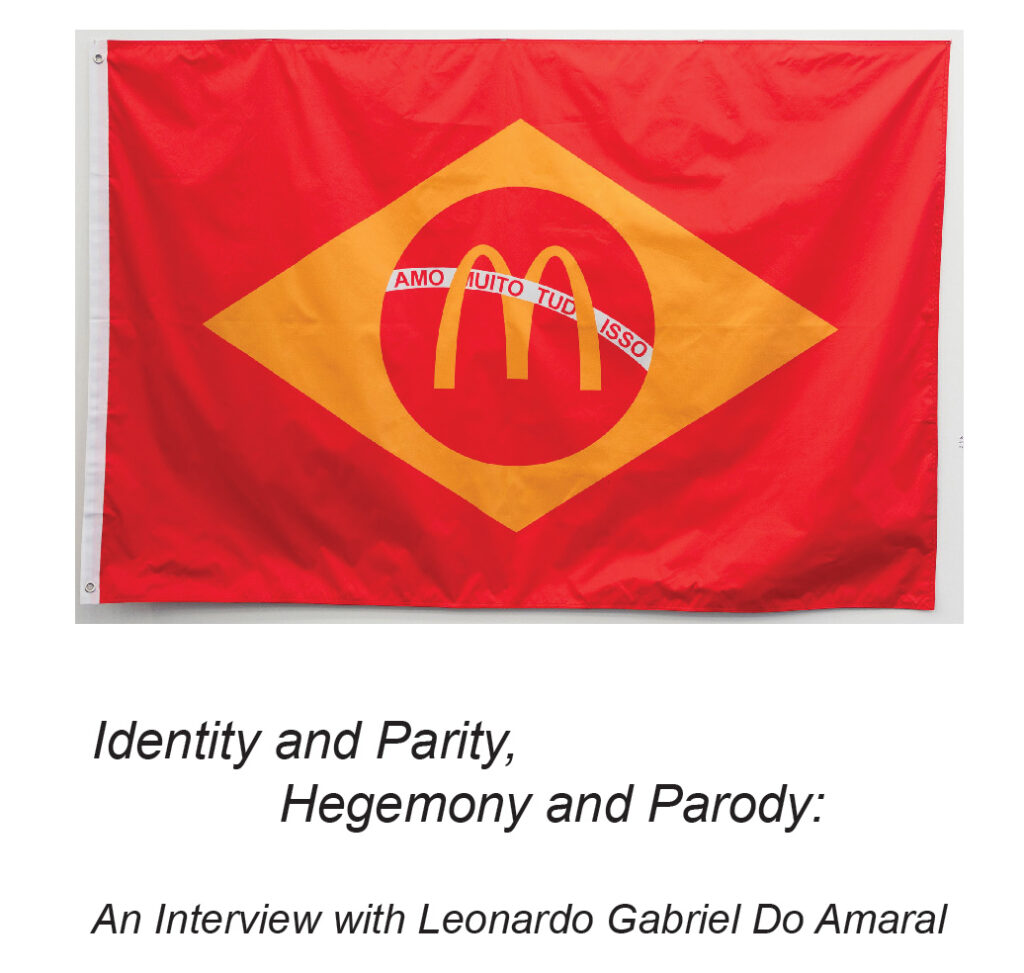
So, it was composed of four flags from a series of mine called Colonização Cultural, which is Portuguese for Cultural Colonization, where I take the Brazilian flag and re-design it based on different American company’s logos and brand booklets. So, I’m going through all of their internal communications to make sure that I’m following the rules of the brand to make these sort of parodical flags that talk about how our country, and countries around the world, get taken over my American companies. Another body of work in the show was this series of framed Brazilian clothes, with air quotations around “Brazilian clothes”. I had a faculty member once tell me that I didn’t dress like a Brazilian and that really stuck with me. Like I said, I try to be nothing if not fair, so I was like well what does that look like? What does it mean to dress like a Brazilian? So, I started looking at all of these shopping websites and I would just look up “Brazilian clothes” and started documenting all those results. I started purchasing them and building these frames for them to be inside, made out of Amazon packaging. So, with the flags I’m talking about how America takes over other countries, but in this one I’m talking about how America profits off of the exoticized versions of those countries, because I’m doing all of the transactions through, like, Amazon and whatnot. And then lastly, there was a performance piece that was actually one of the more recent parts of the show, the only part made during the Fall rather than the Spring. And, basically, with Colonização Cultural, a lot of my conversations with people always ended on like, okay but these are gonna die in a studio, or die in a gallery, these need to be outside. And a lot of folks were like just do it, just activate public space and take them out there. But as a Brazilian in the United States I’m terrified where that could lead me, where doing something like that could end me up. So, instead I did this performance piece where I’m carrying the McDonald’s version of the Brazilian flag in a Trader Joe’s bag, and carrying it from the Brazilian consulate here in Chicago to the nearest McDonald’s, which is like a 15-minute walk. And basically, I’m explaining why I’m doing this performance instead of the performance that I wanted to do, and I’m doing the whole thing in Portuguese because it uhm…it made me feel somewhat safer, which is really interesting because whenever I tell people that I did that they’re like oh wow, you must’ve been putting yourself in so much danger speaking Portuquese on the street, but I was like no one can understand the things I’m saying when I’m speaking Portuguese, so I at least have safety in that, in a way, whereas if I had been speaking in English I’d be really worried about some of the things I was saying in that performance.
MB: Yeah, that’s very interesting. Well, it was a fantastic show and I appreciate that in-depth explanation of each of the elements of it. It definitely raises some immediate questions for me. I guess first of all though, before I ask you one of the more reflective questions, and again for people who didn’t see the show, can you talk about each one of the flags in particular, and the sort of symbology that each one mobilizes in terms of the companies that you were referencing?
LA: Of course. I’ll start with the Amazon one, which I titled Order Progress because on the Brazilian flag is says Ordem e Progresso, which means Order and Progress, but I thought that calling it Order Progress was funny.
MB: (laughter)
LA: And basically what happened with that is that I one day I saw the logo, like that smiley thing that they have with an arrow through it, and I realized that if I turned that upside down it would look a lot like the sash that we have in the center of the Brazilian flag, where it says Order and Progress, so I just put that on top of it. And then I looked at Amazon’s branding colors and started color swapping different parts of the Brazilian flag until it felt right. I’m trying with all of them not to deviate that far away from the basic pattern of the Brazilian flag.
MB: Well, one thing I noticed very quickly is that there’s something serendipitous about the Brazilian flag with respect to the designs of some common corporate logos. It might have been a more difficult concept with a different flag design like that of the French flag, for instance.
LA: Yeah, that really ended up being just happy coincidence how much it allowed itself for something like that. But yeah, it started with the Amazon one, then I did the American flag one, because I was like this is pretty simple, I’ll just do a color swap and then change the text to English. And originally, I wasn’t just thinking of companies, I was thinking of, like, alternative futures for Brazil, and so I was thinking like, oh what if American just straight up colonized Brazil at some point in the future and tried to take over our land. So then, I was like, what if we fell into a fully, complete narco-libertarian sort of society and then I thought about what it would be like if Amazon was like a country, like a State, and what if countries were run by Amazon, and that was kind of the thought process there. And then I kept going with companies, because I just realized that they were a lot more recognizable and it was working better for the point that I wanted to make. So, the other two flags that were there were the Disney one, which, that one was interesting because even though Disney does have its official colors, that wasn’t even necessary, I just took the circle at the center of the Brazilian flag and I just gave that ears. Then, in Portuguese, I wrote “the most magical place on Earth”. And then there’s the McDonald’s one, which I did do a full color-swap of. I always tried, with the company logos, never to break the rules too hard but rather to bend them. So, with the McDonald’s one, that’s something that I did where I had the sash sort of go around and under the “M” of the McDonald’s. I think it goes on top, then under, then on top of it again. The text written on it is the Brazilian slogan for McDonald’s, and the title of it is just Méqui, which is spelled M, E with an accent mark, and then Q-U-I, which is how people sort of colloquially refer to McDonald’s in Brazil. It’s strange because people refer to McDonald’s that way so much that they’ve just started using that in their advertisements, it’s how they spell it in their own ads now. It’s this weird corporate synergy kind of move that I’ve never really seen another company do.
MB: That’s very interesting, this kind of ambiguous fusion between the national-political and international-commercial spectacles in these objects. So, a question I have that I think a lot of the exhibition seems very resonant with is a question that circulates not only around the matter of identity, but also the shadow of identity, which is the issue of alienation. Alienation seems to be a big part of things here, both your own alienation as a person far from home, in America no less, but also a possible alienation between the audience and artist. In particular, in the performance you’re speaking Portuguese, a language that not many Americans understand. And also, you’re sort of relying on these corporate symbols and iconographies that very much speak a language of detachment and distance. So, if an art object is something that very often instigates a convergence of artist and audience, this instead uses the alienating corporate iconography to push them apart, to alienate. I’m very interested in that, and you’ve already touched on some of the essentials, but I wonder if you could elaborate on that further? The mobilization of alienation seems to be at the very core of this body of work.
LA: Yeah. I think that alienation is something that’s been such a huge part of my life even before I came to the U.S. Growing up, I was raised bi-lingually for no reason other than just, like, my mom thought it would be really helpful in the job market. She was like, he needs to know this, because she was teaching English and she saw how difficult it was for people in their 30s and 40s to learn a new language from nothing, and so she taught me. But that gave me this sort of expedited access to the very phenomena that I talk about in my work now. I think nowadays, most of my friends, even if they didn’t go to a bi-lingual school or anything, know how to speak a pretty good dose of English and that’s just because they grew up so online and have continued to be online, and because they go to the movie theater and every movie is in English. And I think that that does inherently create this alienation between yourself and your country and community. And it definitely was the case for me growing up where I felt very quickly, like…and well, I mean this also has to do with like, I’m not gonna sugar-coat the fact that I was a loser as a child (laughter), but I think that it was very difficult for me to connect to, and relate to other people when all of my cultural references were completely different from theirs. I mean, the value of different pieces of art, and music and entertainment, you can argue about that forever but I’m more so just interested in the alienation that came from feeling like, oh, they’re having an experience with their culture and each other that I’m not having. So, that was a big part of it. And I think that my sort of naïve hope when I was a kid and a teenager was like, oh I’m gonna go to America and I have like all of the references down, like I know them.
MB: In America, maybe you won’t be alienated.
LA: Exactly, I won’t be alienated. I got all the stuff. And when I would come here, when I did two summers of college courses when I was in high school, I would come and meet people and like, think like whoa, this is happening, I’ll get to reinvent myself around them and around this shared knowledge. But then it would quickly sort of start to crumble in places, like I remember even as an undergrad, which wasn’t even that long ago, having people come up to me and be like, hey say something in Spanish. But that’s not the language that we speak in Brazil. Or asking me like, if the women there are really hot, and just asking these really slightly pointed and xenophobic questions. So, there was that kind of social alienation. And then there was a governmental level as well, which was like, you know, oh I want to work, well…you can’t. Oh, I want to do this, well you can’t. And so on and so forth, so I think that it’s something that is always going to be present in my work, there’s some degree of alienation. And then as far as, say the flags go, for example, I think that they’re such, like, very cold objects. They’re loaded, don’t get me wrong, I think a flag is inherently very loaded with ideas of sovereignty and nationalism and stuff like that, but no one really like…well you know, you walk past a ton of flags every day and no one really stops like, oh let me marvel at the American flag.
MB: Yeah, it’s a paradoxically charged banality. Something overcharged that you also just easily ignore.
LA: And we always walk past these logos as well, like on the street, we don’t really pay them any mind, so in putting these two things together in an object, I was very careful to make sure it looked corporate, and looked it was designed to be corporate. I think it does something interesting where it doesn’t make an audience member stop in their tracks because of like ooh, ahh, pretty! It is almost a non-aesthetic object that makes people stop in their tracks once their brain makes the connection between the two things being presented. And so, I think that process of pulling the rug out from under someone’s feet is something that I’m really drawn to. Like, playing and tricking people is very fun. And, I feel that way about the clothing in Amazon boxes as well. But with the boxes I think it has more to do with the material than the content. You’re like oh okay, some clothes in a frame, and I guess the clothes should start to tune you in, but then you see the frame and it’s not well-made, so you look closer and it’s just cardboard taped together haphazardly and glued with mylar and all these other things. And I think the video that sort of set alienation in language is interesting because when I was filming, the main concern was just using language as a protective device for myself. And I don’t want to fully alienate people, which is why it has subtitles on it. But I do think that it helps further the sense of feeling kind of lost, because that’s really what the performance is about, like in it I talk about the rules to some of this stuff not being clear, where I’m like, what is it that might get me in trouble? Why can’t I carry a piece of fabric that I designed around the street without feeling afraid? So, I think presenting that in a language that isn’t English has a similar effect on the audience, where they’re caught a little off-guard, made a little confused by it. And there’s also an opening for slippage as well, where some people might be like, you know, are you really saying what’s in the subtitles?
MB: Ah right, there’s the possibility that you’re acting as an unreliable narrator under the cover of translation.
LA: Yeah, and I mean, I am (laughter). I am saying what it says I’m saying, the subtitles are legit. But that was something that came up during the show a couple of times. And I think that creating room for these questions is good. I don’t want people to feel totally alienated from the work where they’re like I have no idea what’s going on and he’s not giving me any reason to care. I’m more interested in using that alienation as a device to surprise people. I think it’s fun and I think it’s a way of getting people to care about stuff in the modern day.
MB: Brilliant. I like the strategy. The next question that I have, thinking for example about the clothes in the boxes with shipping labels on them, there seems to be a very definite element of humor or parody, I’m not sure which word you would pick, but, in any case there’s a sort of unseriousness that’s being mobilized as play. I think you used the word play.
LA: Yeah, that’s right.
MB: Well, you know, I think that play, and the structure of the joke, can be really radical sometimes. They can have an incisive political edge and effect, and I guess I just wonder, in an open-ended way, what is your relation to humor, parody, the joke, and so on, with respect to the themes we’ve discussed but also just in terms of political potency.
LA: Yeah. I’ve always been into satire, political satire and what that can do. This is a really interesting question because I think there’s a lot of ways to tackle it. But I think at least in my own practice, and in a lot of the art that I’m interested in nowadays, it fits into what many now call post-irony. It’s is sort of like wearing the skin of irony, but to deliver something very sincere. And so, I think that in a time when were bombarded by content…I can’t even say information, because its barely information, it’s just content and stuff to stimulate our dopamine receptors until kingdom come.
MB: Purely sensorial content.
LA: Exactly, and even with so much information, when you have so much knowledge available at all times of everything that’s happening in the world and how bad it is, it’s almost a natural human response to become de-sensitized by a lot of it. And so, I think that post-irony and parody as strategy comes into play there as well, if you can, again sort of like trick someone into paying attention to your thing.
MB: With a covert earnestness.
LA: Yeah. Well, more so it’s like you trick them by making them think that it is just the thing that they’re used to seeing, making them think it’s just funny, a joke, haha, and then later on it reveals its earnestness to them. I think that’s some of the feedback that I got on the flags, at first, it’s like oh wow, these are pretty well-designed, and then it’s like, oh wow these are kiinda funny, and then it’s like oh wow, this is actually kinda gross (laughter). It’s kind of awful. So, I think of post-irony and parody right now as a strategy. It makes a lot of sense as something that I’m really drawn to in the art that I like. Humor in general…I feel like everything I make, I think of it always as like, oh this is a little bit funny. And of course, not everyone thinks it’s funny. I tell some people that the flags are funny and they become really serious and they don’t find it funny. So, I think that’s just the kind of power of parody has as a device.
MB: Well, that’s really interesting, because I’m thinking about those who aren’t able or willing to buy into the sort of post-ironic move. It might appear to them as plain old irony. And then there’s a possibility of a perceptual regression, a kind of fall into cynicism. Like a sort of malfunction or collapse of the safety net of the gesture. And since that’s come up, I guess I’m curious whether you try to anticipate that? Or more to the point, do you worry about that, or try to guard against it? What’s your relationship to the possibility of someone not registering the post-ironic move, and therefore not finding it legible as an invitation to something more earnest or honest?
LA: Yeah, I mean, I think it’s something that I think a lot about because a lot of people tend to conflate post-irony with meta-irony. It’s like, if post-irony is this returning to sincerity from irony, then meta-irony is like this irony-poisoned state where you’re not really saying anything that means anything.
MB: Irony squared to the second power.
LA: Yeah, and that’s something that I worry about because while I do think that meta-irony can have its place in satire, that’s not the place that I’m in right now. I have been in that place, and I think that meta-irony has its use in the sense that like, a lot of meta-irony is just pointing at something, but I do still think that pointing at something has its value. So, even if someone interprets the work as just, I don’t know, what was the word you used? Cynical, like a cynical approach to this situation. It’s like, well yeah, I mean in part, it is a cynical approach to this situation, because it’s difficult to witness and to be a part of. So, there is a bit of cynicism in there for sure.
MB: That’s interesting, it’s as if you’re turning cynicism in on itself but in such a way as to deactivate it, or to re-mobilize the thing that cynicism is eclipsing. Honesty, or whatever we’d call it.
LA: Yeah definitely, I think that cynicism can have its place and I think about it alot. I try my best to make sure my work isn’t drowning in it. There’s always some sense of play, because I do think that play almost inherently prescribes a sense of hope to something, in a way. I think that you can look at something like the flags or the boxes and think, yeah this is cynical, but I don’t think you can look at it and be like, oh this is a very doomer piece of artwork. It’s not that. It’s just stating reality, essentially.
MB: Well, I think this goes back to something we were discussing before the interview started when we said that some of the work is operating like a Trojan Horse, right? I think this was a phrase we landed on earlier. There’s an outer appearance and then these things have an interiority, and those two things oppose each other. They misalign. We have to work through it. So, I guess this leads to a question. Is this a paradigmatic necessity of our epoch, where in order to find hope or happiness, we have to work through a situation where everything is occluded by a kind of cynical, corporatized veneer that we have to punch through? Is that a way of thinking or a problem that animates your work?
LA: Yeah…(contemplating)…I think with the work in the gallery, from Not In America Through, the corporate thing had to be a part of it, because that is the very thing that I am critiquing. So, I’m using parody as a mode to sort of embody the thing that I’m criticizing. That is a way that the criticism can gain a lot of strength, right? But I don’t think that in general, in art, that always has to be the case. I do think that post-irony is super interesting because of the way that it disarms people. I think that tis a very strong strategy for the time being, but I do believe that it really depends. I wrote an article about this recently that isn’t out yet, but I think it’s easier to trace some of these movements in other mediums outside of like…fine art. So, I was writing this article about a lot of recent post-hyperpop albums that have come out that I feel are closer to just baseline sincerity than they are to post-irony. Like sure, they’re still borrowing a lot of elements from musicians of the past, but I feel like we’re on the verge of being able to be like full hope-core, sincerity-pilled.
MB: Well, let’s hope so, that sounds great. Uhm, I guess that other question I have, the last sort of semi-premeditated question, is about the exhibition reception night itself for your show. As I understand, there was some last-minute controversy, some last-minute stuff that went down. Why don’t you tell us that story in whatever way you’d like to tell it?
LA: Absolutely. Well, I proposed the show to SAIC’s Incubator back in I think November. Around December I hear back and they’re like, you know, we’d love to give you a show, we’ll be in touch with more details later. And, when I was in Brazil, over winter break, they reached out to me and said they’d love to have a show basically the second week of school, so we’d have the first week to install, and then we do the show. And so, while I was getting ready to leave the country, and even my first week back in the States, I was working on promotional materials for the show, working on wall-text for the show, and the whole process was going great. Working with the folks over at Incubator was a really wonderful process and they’ve always had my back through all of this. But on the last day of the install, which was the longest day, all the trouble-shooting was done and it was just a matter of putting stuff up, and I started hearing like, oh hey actually you sent this image of the McDonald’s flag to use with the SAIC post, could we instead use the American flag for that? I was like sure, here’s the file. And then, at the end of the day at like 6 PM as I’m leaving, they’re like hey actually, we need you to re-design the entire poster. Because the poster was originally the three flags there were hanging outside, so the American-Brazilian one, the Amazon one, and the Disney one. They asked me to re-design the poster and just use the American one. So I said sure thing, will do. So I re-designed the entire poster that night, and sent it out. At this point we’d already printed all of the other posters, so thankfully they didn’t take that out of my budget, but…yeah. Uhm, so I did that, and then woke up the next day to an email that’d been sent at like 2:30 in the morning, telling me that, hey the show is on hold, we don’t know what to do from here, it’s out of our hands. They said that basically the show is in the legal department and the deans are reviewing it to see if it can carry on or not, and they’d keep me updated. At that point myself and the people at the gallery knew the same amount of information, so we we’re waiting to hear from people higher up, but I wasn’t hearing from any of them directly. I was just hearing what the people at the gallery were telling me. And, it was only Sunday at probably 2:00 or 3:00 in the afternoon when they were like okay, you’re good to go, the show has been approved, here are the changes that have to be made. And the changes were that we were now gonna run with the new poster instead of the old one, that all of the takeaway cards that I’d made for people to take from the show would be thrown away. One of them was the McDonald’s flag and another was one of the framed pieces of clothing. So, they were like yeah, we can do this but it’s just gonna be promoted differently. And then, on the day of the show’s opening, the school’s official pages that share stuff, like this week’s email blast and screen displays around the buildings have nothing about the show or its opening on them. That also made it difficult for me because I had to reach out to people on Monday morning to tell them hey there’s a show happening so you should come, because I didn’t want to confirm the show to people over the weekend because I was kind of sussed-out, like it might not happen. So, that was something that affected the reception a little bit, and also just affected me and my time, because if I thought I’d have to re-design the postcards and the posters for the show I wouldn’t have designed and printed them up in the first place. Uhm, so yeah, that was I guess the like, controversy that happened around it. That was it.
MB: I see. So at base, the whole dialogue was about things like copyright issues and logos, and this sort of stuff, right?
LA: Yeah. It was the logos, mostly on the flags, which seemed to be the main concern. And that concern only really popped up when we sent over the promotional materials for the email blast that the school does. They were like, oh, we don’t know if we can include the McDonald’s logo in this, which I think got them asking like, hey wait a minute, what is this show showing (laughter). And then they saw what the work was and were like oh my god, okay, send it to the lawyers. There was even a brief moment on Sunday when they were like okay, you’re show’s good, and then an hour later I get an email and they’re like hey, you’re wall-text might need to be taken down. And then an hour after that they’re like never mind, its fine. It was just a lot of going back and forth.
MB: So, it was problem that lived and died in legalese, imparted from the world of lawyers for the world of lawyers. That’s really interesting I think, because it means that there’s a sort of meta-aspect to this whole thing. Here you are making a show about corporate power and influence over our social and global lives, and the cultural hegemony that they’re capable of wielding, and then these very forces influence, as from above, a very sort of technical kerfuffle over it and nearly shut the show down. That really circles back to alienation too, right? Because none of it was ever like, unlawful or anything. It just had the capability of making certain people worried or, above them, making other people angry or, at worst, instigating a litigious impulse within the gears of corporate machines. You were told that you’re not allowed to do something that is, in fact, permissible in a general way.
LA: Yeah, and some people were like well did you even think about what you were doing? And I’m like yes, I was thinking about what I’m doing. It falls under Parody Law. And they’re like, well these companies have a lot of power and money, like, if they wanted to bury you under a lawsuit they could. And I’m like, that should be something that I get to opt into or not. Are you kidding me? If McDonald’s sent me a Cease-and-Desist, I would turn that into art (laughter). What was really frustrating though was just having it all thrown at us right at the finish line, and having no control and no say in it. The gallery defended me to the best of their ability, and sited Warhol as an example of artists reappropriating logos all the time in Contemporary Art.
MB: Yeah, there’s something almost anachronistic about it, as if art history hasn’t been here before, hasn’t already gotten past this supposed problem again and again.
LA: Yeah, definitely.
MB: And also, I would have to say that as much as you were logistically blindsided by just the last-minute back and forth, it seems to also be the case that the higher-ups experienced their own kind of blindsided moment. Had you kept your cards a little lower under the table with intention, hypothetically speaking of course, you might have pulled off a real controversy at a time when it had become too late for the emergency brake to be pulled. The last-minute stuff with your show was all a product of unexpected circumstance, but do you have any interest in things like that being made to happen on purpose? Could you see yourself operating as a kind of institutional prankster who sets up unexpected problems?
LA: I mean, I do think that it’s interesting. I was inspired, around the same time that anecdote happened with someone telling me that I didn’t dress like a Brazilian, when I went to see an artist talk by Wafaa Bilal. And I was seeing like, how hard he was pushing the envelope and how pissed he was making people.
MB: Was this tied to his recent MCA show?
LA: Yeah, yeah. And I was really inspired by it. I’ve met up with him before and talked about the work, and he really is always telling me to like, put myself in crazy situations like, oh you should go take down some American flags and put up yours. And I’m like that would be great but I’d get deported. And he’s like yeah exactly! (laughter) That would be a great chance for art. And I’m like okay, but I do want to be a bit more careful than that.
MB: Bilal goes hard.
LA: He goes very hard. And you know, I certainly do see a place and importance for that. And I mean, Ithink even when we were going through the motions of what was going to happen with the show, I was already thinking of creative solutions around it, and I’m almost a little disappointed that I wasn’t allowed to do any of them. Like, I was like hey, can I just go ahead and put electric tape over all the logos since you guys had a problem with it? It won’t be in the poster anymore. And they were like no, you can’t do that. And so okay. Then I’m like, well how about this, you don’t want me to use the postcards, so how about we use a frame from the video, from the performance piece, where I’m saying in Portuguese that it’s not clear what the rules are, and use that?
MB: Ah, brilliant.
LA: But they’re like, no you can’t. So, I was willing to try to work around the problems that came up creatively.
MB: Those are great ideas. I think you’re right that on one hand, it’s a shame that you didn’t get to realize them.
LA: Yeah, because I was like well, okay then if there’s a problem then let’s do this, let me play. Let me play with what’s going on, and let me be funny about this. I think that if something like this does happen again, then this is the strategy of play that I’d like to take with it, to make it into yet another critique of the system itself, but it’s not something that I want to necessarily encourage in my practice. If it happens then I’ll try to be an artist and work around it, but I’m not so interested in going and instigating logistical problems. Controversy for the sake of controversy is not something that I think I’m very into.
MB: Right, right, gotcha. I do think there’s something in what you said a moment ago about play that allows a gesture to escape the trap of controversy for controversy’s sake. Doubling down on a so-called controversy can also become a doubling down on play that takes root around it. But it has to be organic. It can’t really be too forced, or else it short-circuits. It can’t be staged.
LA: Yeah, uhm-hmm. Exactly.
MB: Great, well wrapping things up, let’s talk about what’s on the horizon. You’ve got your MFA show coming up.
LA: Absolutely. Since the Fall, I’ve been working on trying to make these struggles around alienation and distance more personal. So, I’ve been focusing on that feeling rather than the systems that breed it. That’s from a criticism that I’ve gotten about some of the work from Not In America But Through, that it’s not really that personal. It’s kind of broad. And I’m not going to tuck my tale in between my legs and just be like okay yeah, you’re right. That work has a place and time. But I think that the work I’m making for the grad show is a lot stranger and more conceptual and about trying to create this interstitial space that I feel like I inhabit so often where I feel like I’m neither American nor Brazilian. When I’m in the US, I find myself missing Brazil, and when I’m in Brazil, I miss the US. Focusing on those ideas is what I’m really doing right now. I’m playing with sculpture and installation work right now for the most part. But yeah, I don’t really know quite what that’s going to look like right now. There’s still a lot of experimenting happening in the studio, a lot of conversations to bring out. But I always like it when something is challenging for me, so it’s not to say that I won’t return to any of the works that I’d been working on with Not In America Through, but I’m taking a bit of a break from them now because I’m always interested in pursuing ideas that are difficult to me, and right now the ideas that I’m pursuing feel difficult. And once I sort of crack them, then I’ll move on to something else.
MB: Cool, cool, that sounds very exciting. I’m looking forward to seeing how you tunnel further into the really subjective aspects of these experiences. So where can people see your next project on exhibition? What are the dates and times of the upcoming show? And where else can people find your work out in the world?
LA: The MFA show is from May 8th through the 20th, at the SAIC Galleries at 33 W. Washington Street in Chicago. The public reception is May 13th, from 5 to 7 PM. I also have a show that I’m doing right now in Bogotá, Colombia, of some older work of mine. And I have an article in coming out soon in Clot Magazine, I don’t know exactly when that’s coming out yet, I haven’t been given the date, it’s being reviewed now.
MB: Okay, sounds great. And we’ll plug your website and socials down at the bottom of this transcript. Leo, I want to thank you for being so generous with your time and your thoughts today. I’m very excited about your upcoming projects and I’m sure that many of our readers are excited by now as well. I will keep an eye on your work and I look forward to seeing you again soon.
LA: Absolutely, thank you for having me.
END TRANSCRIPT
IG: @leomaybeleo; website: leomaybeleo.com