Written by Mark Banks
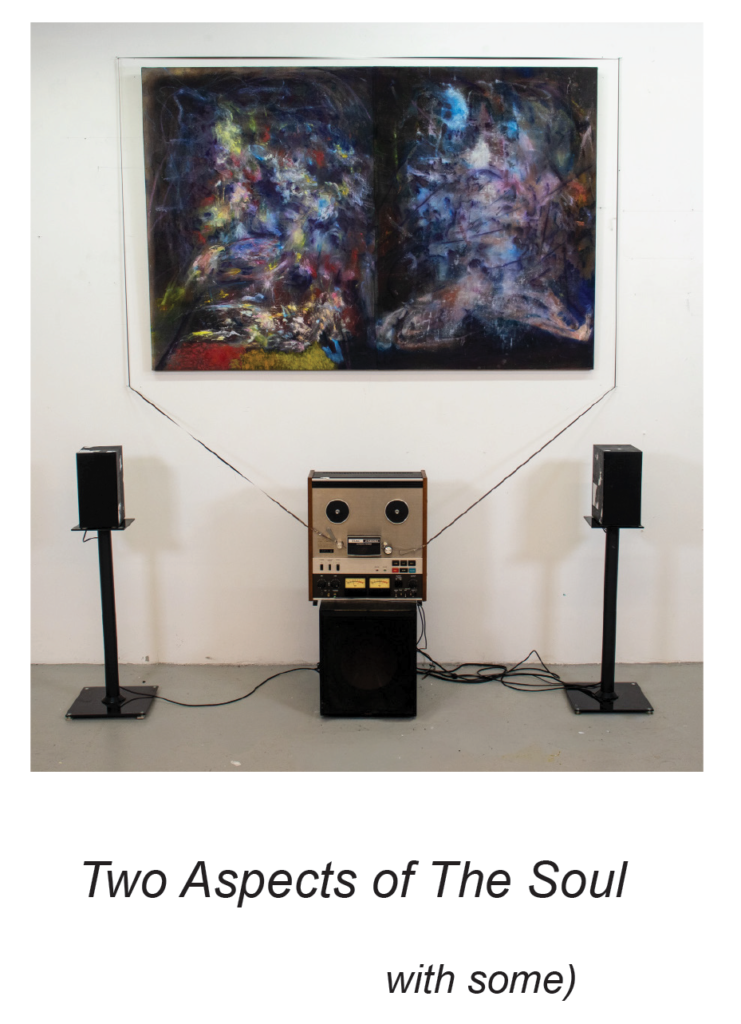
A painting called Two Aspects of the Soul, by the artist some), is hung on the wall as part of a heterogenous installation. It hangs at an unusually high level, more reminiscent of a Church altarpiece than a gallery display. It combines with an audio-recording called Culmination Collage #3, played aloud through speakers. A second audio track titled Aleotoric Collage #6 is recorded on a disemboweled loop of tape running through a player and also running around the entire space of the installation like a circulating umbilical cord, delivering information. Headphones are plugged into the player’s jack (not shown in photo above), inviting audience members to listen in on this second track, as though eavesdropping upon the interiority of the installation’s electronic homeostasis.
According to some), the painting started as two independent halves, eventually joined into one canvas. Their material joining heightened a reflectivity between them that already inhabited the images: the mirrored relation of their forms reminds us that the gaze can be made to look inward and outward at the same time, whenever it stares at the perceptual magic of a mirror’s surface. This reflectivity is here, however, an uneasy one. It reflects not only the painting’s relation between its two halves, but also their inner oppositions. This is because the left side of the double-mirror painting immanently expresses a definite vitality, while the righthand side seems to exude a visual grammar of desolation. In this way, their combination is a reflection but also an inversion.
The relation of halves therefore appears dialectical, constituting a totality through an internalized opposition. The painting’s symmetrical relation, which is also the relation imposed upon everything by every mirror, is redoubled in the installation’s surrounding geometry, which can be reduced at the level of the imagination to a triangle embedded within a square (formed by the arrangement of the painting, the speakers, the revolving audio tape, and the floor). In addition to the Kubrickian symmetry of the mise-en-scène, the doubled audio component further escalates the symmetric mirroring effect, with left and right outputs awaiting the doubled ears of our symmetrical heads, just as our eyes, which also double each other, look out at the painting’s halves that mirror us back while also mirroring themselves. Everything appears tightly bound up in a sharply divided logic of reflective binaries, seemingly packaged as a dialectical totality within a Euclidean panorama, like a hall of mirrors. The geometrized composition, at a glance, almost suggests proximity to a Platonist formalism.
But upon closer inspection, this seeming proximity to Platonism is a grave interpretation error, a ruse played by the audience upon themselves. In fact, the situation of the piece is wildly up for grabs. First of all, the painted aspect of the work, with its false lure of a totalizing, mirrored binary, is hardly representative of any complete set of all possibilities. The pairing of the mirror’s two halves is only one possible pairing of halves amongst many. It is not the pairing of the halves. Each painted half could have been painted any number of other slightly or dramatically different ways, and their binary confinement is a product of our own imagination, not the painting’s real limit. Because of this, the painting’s apparent doubling escapes its own limiting logic and lives in a soup of virtual potentials that allows any quantity of multiples and variations. There can be hundreds or millions of discreet spectral offshoots. For every pair of partial reflections, there is another pair of pairs that mirror and differ from each other in alterior ways, and for each of them, two more exist, and so on ad infinitum. Nothing but the continuous spectrum of difference straddles the indefinite threshold that divides the painting in half. It is not really dialectical. It is infinite.
What this means is that at the threshold of the painting’s possibility, the number two is not enough to organize its idea. To count all of the immanent possibilities, we must instead ascend immediately to the limitless threshold of infinity. There, at the plane of the infinite where the painting’s true limit is discovered, the form of the mirror’s binary reflectivity explodes into a supernova of kaleidoscopic hallucination. In fact, even the apparent symmetry itself is a ruse. If you look close enough at the individual brushstrokes, the mirror effect collapses. Each half of the painting is entirely unique and incommensurate with every other painted half that one can possibly imagine or produce. Only their vague silhouettes are capable of superimposing each other, and even that is no more than a rough and crude doubling, a loose approximation of similitude.
The audio takes us even further into irreducible difference, into a decidedly anti-dialectical polyvalence that radiates like sunlight in all directions at once. The left ear and the right ear do not hear the same tracks, nor does any track remain consistent, instead jumping across space and time from one spliced audio moment to the next. In the manner of a rhizomatic drift, or a Situationist dérive through soundwaves, the audio transports us but does not guide us. It forces us to contend with irruption and suspension, with coming and going, without ever having a destination. This is perhaps why the audio loop is made visible as a literal loop: it is looped not merely in the audio-recording sense but in the material sense of a circle that binds the enclosure of a magical space of ritual. The arrangement, with its contentious, unreliable truths and its ambushes of one surprising aporia after another, are not acts of malice. The ruse is ultimately a liberating one, set up by a magician of the imagination, through a series of interlocking gestures that (1) set up familiar expectations only to (2) undo them through a rapid shifting of ontological frames. Like the tape that both repeats its magic circle and radiates its unpredictable cacophony in every direction, the piece as a whole immerses us in an experience whose center is always de-centered, whose gravitational core is dilated, and whose sense of reality is always incomplete insofar as it is always still growing. It is the sort of beautiful chaos that would have driven Plato mad, and perhaps only a modern pathos can appreciate. It is, we might say, the aesthetic of the wonderful accident. To encounter this work is to ascend horizontally and laterally at the same time, as upon the escalating and widening curve of an elongating spiral, in a state of perpetual evolutionary motion along an uncharted and unchartable course.
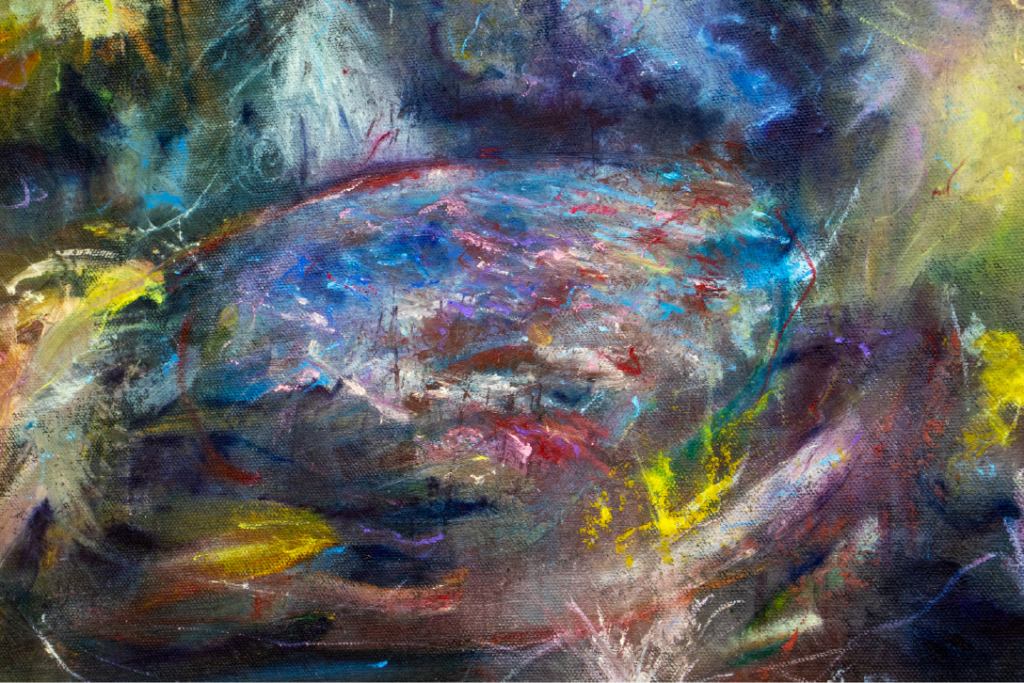
Twin Aspects of the Soul, detail
oil on canvas
2026