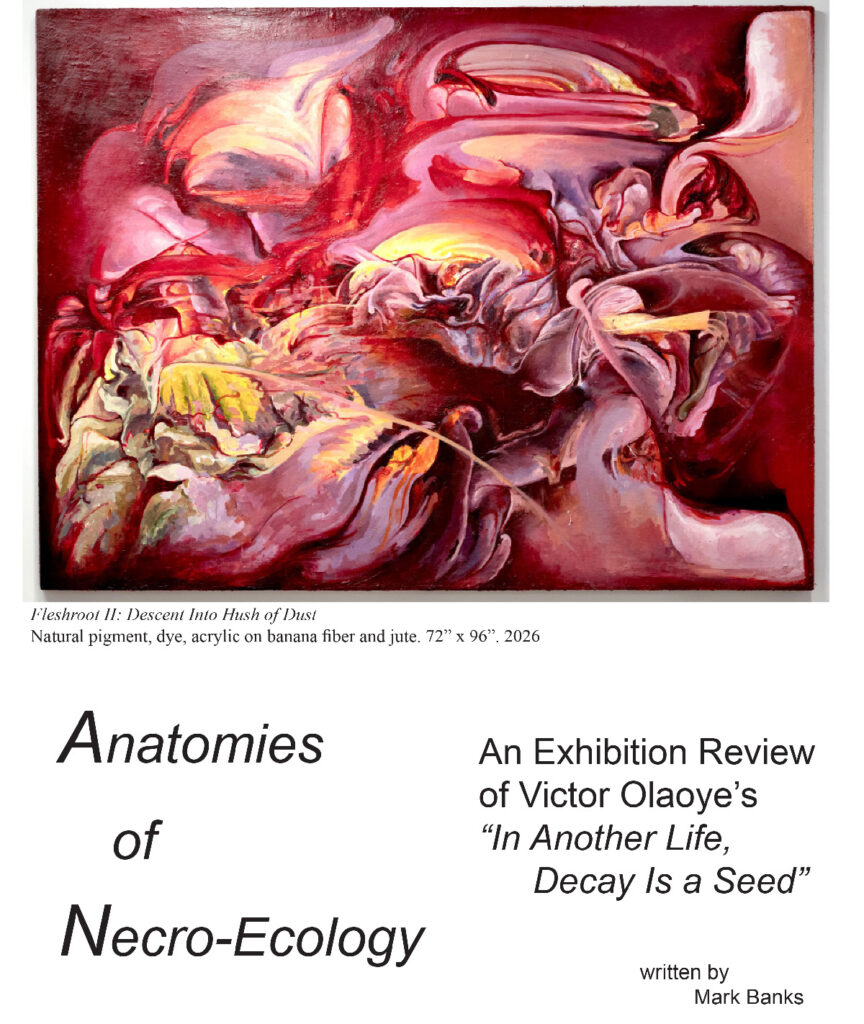
In the visions presented by the painter Victor Olaoye, at his School of the Art Institute 2026 MFA graduation show titled In Another Life, Decay is a Seed, living matter appears encased in the painted image as in the eye of a swirling vortex. His brushstrokes settle into an endless cycle of cycles of life and death. His painted world, like our own, is one of perpetual becoming and unbecoming, of churning and metamorphosis. The partial and partially dissected figures that inhabit his large canvases do not, on account of their fragmentations, appear mutilated. They are not on the chopping block. Instead, they twist and agonize in organic promiscuity. They enact an ambiguous dance of folded anatomies, each adapting rapidly to forces around them like a tangled evolution of species.
The work that Olaoye does seems to engage all valences of the world’s material being, and fittingly so, because all the world is part of this spontaneous choreography of matter and animacy that he shows us in paint. From the animal to the vegetal, he develops an ontic line of continuity that stretches one region of animated matter out to another, linking separate domains across improbable circuits. The leaf of a plant, the viscera of the guts, the placenta of a newborn fetus: they all converge at a plane of undifferentiated being whose laws of formation are dictated by the application of the paint itself. There is something exceedingly primordial in it, something in each large work that pulses and inflates spasmodically like a gigantic lung affixed to the wall. Underneath the surface of the paint, you can almost hear the gurgling murmur of blood flow, pumping through the jute fibers of his surfaces.
Those unique surfaces, along with novel pigments, are where Olaoye’s next moves are made. The jute fiber from which his painting’s surfaces are woven are sourced from his family’s land in Abeokuta, Nigeria, where banana trees are grown agriculturally. With jute and banana fibers, both of which would have otherwise been burned as waste products, his canvases and mixed-media fibers are made. The banana fibers, used in mixed-media pieces, are dyed by the artist with naturally sourced pigments. All of the raw materials are sent to his studio from his home country. In the studio, he colors, weaves, and assembles the materials into the supports of his image-making practice.
In this cycling of waste and preparatory materials from one domain to the other, Olaoye materially repeats—or perhaps anticipates—the transfers of subject matter from domain to domain that take place in his paintings. But in this doubling, there is more than a poetic mirroring. The banana plants have been at the center of his attention for a specific reason that is related to their biology and reproductive mechanism. The roots of these plants are rhizomatic, which means that the root system is responsible for the continuous reproduction of the species. This is because new trees grow up from the expanding roots of older trees, in an endless cycle that appears against the backdrop of time as the continual budding of a singular organism from itself, again and again, as its older parts die off and new parts emerge. In the banana tree, life and death are ambiguously united along an expanding lateral and temporal axis, conjoined in space and time as they grow and die. In other words, the rhizomatic banana is a perplexing, living genealogy of animate matter in which life and death appear welded together as proximal extensions of the same thing, occupying each other’s thresholds and realizing themselves in and through each other’s processes.
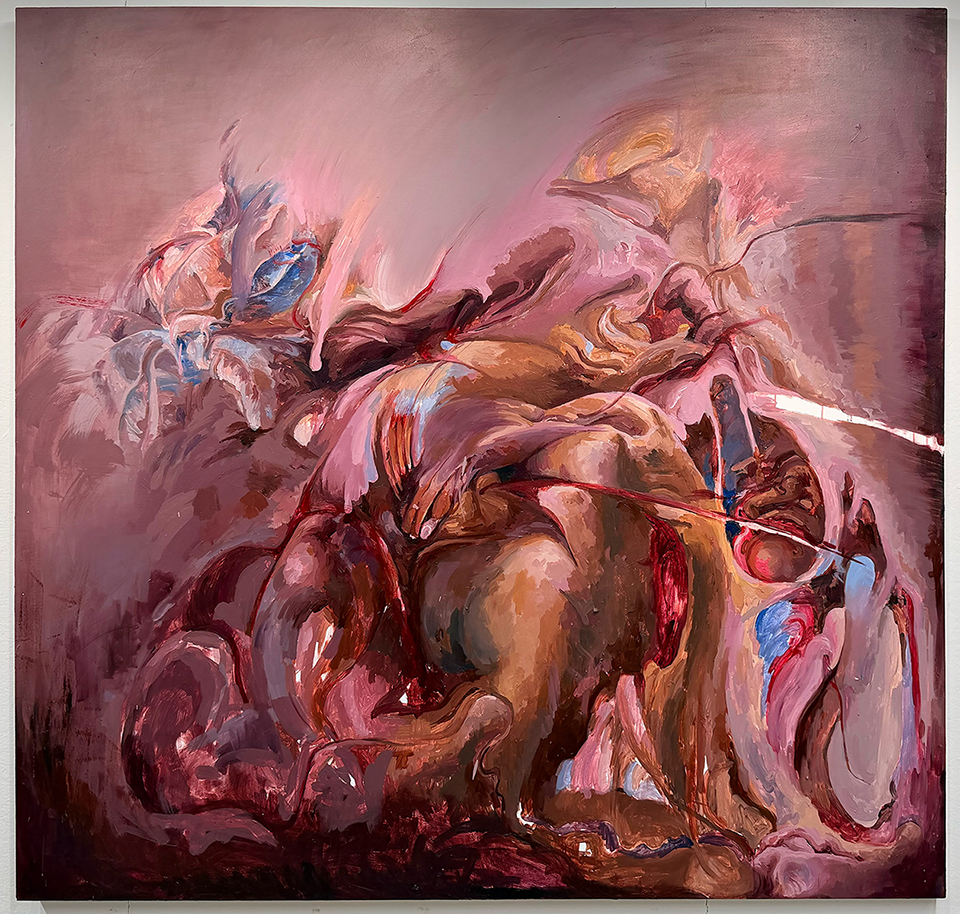
The remains of the banana plant, the cycled jute fibers, and the painted masses of corpuscular primordia in Olaoye’s images all share a common conceptual bedrock in his practice. The conceptual and practical plane that unites them is itself a unity of oppositions, with his thoughts and his painted marks discovering a coherent fusion despite their mutually untranslatable conditions of existence. What we can say with certainty is that the base of his work is no solid base at all, but instead it reveals the unyielding flux of being itself, the disorder of mortality. His practice, materially, conceptually, and aesthetically, is an expression of the mutagenic, the pregnant, the senescent, and the dead, but without fully disclosing the boundaries of being that unite and divide them. Inchoate and yet indulgent in their sprawling totalities, the painter’s forms gobble up their own essences and then rebirth them, regurgitating themselves in layers, over and over.
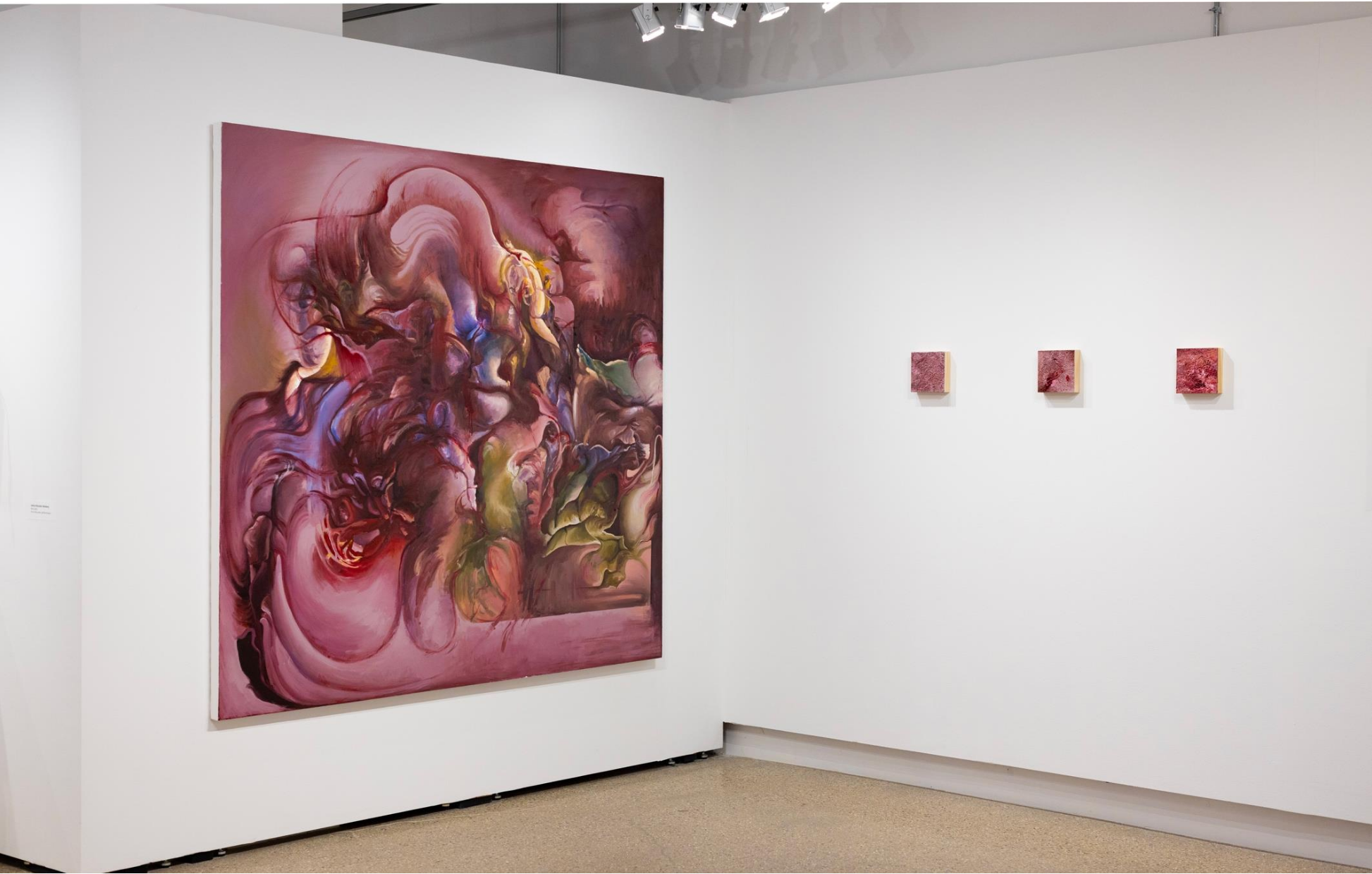
Olaoye’s third move, after image and material, is organized around the question of scale. There are three very large paintings in the exhibition. There are also three very small ones, and an equally small ceramic piece made out of clay. There is nothing mid-sized in between. This creates what appears as the first true gap or caesura in the presentation. Uninterrupted continuities of image and material-cycling are suddenly confronted with an apparent hole, at the level of scale, in the mid-sized range. Has something been left out? Olaoye himself relates that these small works entail a new process for him, discovered and mastered only recently. But any impression of an omission is deceiving. In fact, the strategy of book-ending scales at their extremes (the small and the large) proves remarkably effective. The small and the large, in general, operate at magnitudes that differentiate their features in fundamental qualitative and quantitative ways. These magnitudes introduce unique representational challenges. Whereas the fusion of vegetal matter and animal tissue across a mid-zone of their respective beings is more or less easily achievable in paint, the fusion of the image of the hydrogen atom and the image of the entire planet Earth, for instance, is not so easy to pull off. The large and the small spread further apart than the various biodiversities of organic life do, and so the gulf of representation between the small and the large, the microscopic and the cosmic, is greater than the gulf of formal differences that range across species of life.
And yet, this gulf only puts into parentheses an enormous continuity that is no less smooth and uninterrupted. The gap left in the exhibition’s presentations of scale is therefore not a missing hole but an invitation and a demand to fill-in-the-blank. We have already been given the clues in the images and in their interpenetrations, their relentless continuities. We are therefore permitted to extrapolate the formula of a universal churning at all scales, from the microscopic all the way to the telescopic, from the quantum world to the intergalactic filaments, and everything in between.
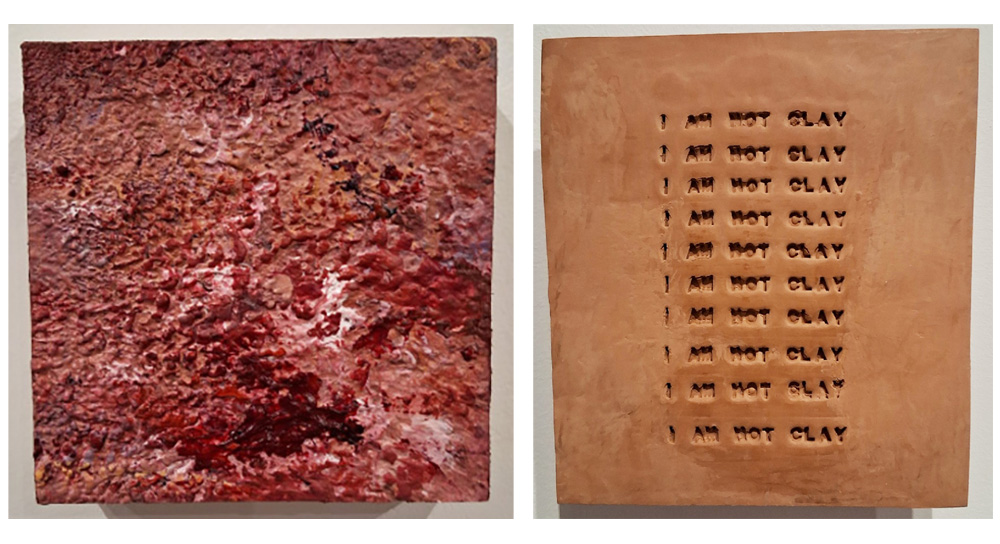
The ceramic piece in the show is notable for its inherent difference from the six paintings. And yet, even at the level of its difference, a connection immediately shines forth here as well. The clay of the ceramic piece is not much different chemically than some of the earth-pigments sourced and sent to Olaoye’s studio. And the words on the ceramic piece are a dead giveaway that a definite existential resolution is lacking, that an open question about the thing’s ontology remains unclosed. The words in the piece read “I am not clay”, repeated over and over again, down the length of the piece. But who is speaking? The artist? The clay? If it is the artist, who accused them of being clay? And if it is the clay speaking, why is it lying to us about not being what it so obviously is? Or is the “clay” merely insisting that it has now become more than clay, that it has transmogrified and transcended itself, that it has obtained not only the status of an expression, but that of art? Or, perhaps, it has ascended to an even higher valence, having become a pure image of becoming, an image of transformation and evolution that must announce its own mutagenic fate through a negative identification (the identification that it is not merely clay, that it cannot be called only clay). The smaller paintings, in contrast, seem to present themselves without guile, telling us the immediate but opaque truth about what they say. They stand adjacent to the other large ones, which seem to give their smaller meanings away, as if the small ones were just little separated molecular shards of the big ones, surgically removed. But these small paintings remain still more opaque than that. They say nothing, in fact. More than the large paintings, they mirror the size and shape of the “not clay” piece. But here there are no clarifying or ambiguating words, no mantric repetitions, no confusion or transcendence of being through the irruption of language. The painted surfaces appear as thick as an elephant’s hide, cracked like alligator scales with an oily sheen like the blubber of a whale. Their flesh “speaks”, but it does so in semiotic silence. And their small size makes the viewer get very close to hear it. Whereas the large paintings seem to shout their grammar of volcanic becoming, the small paintings whisper into our eyes. The same chaos of primordial life is under their surface, but their inner carnival requires a still and quiet focus, like the curious gaze of a botanist who peers at the seeds of life through a magnifying glass.
Not everything in the exhibition is crystal clear. If it was, the paintings would not be as strong as they are. Their uncertainty reflects an uncertainty that we must embrace in our own real lives as we spin along from birth to death within the vortex of becoming. Each wave of change that we experience in life is a new seed of possibility, but this always means the birth of the unknown and the death of the known. One twirls through time without knowing where one is going, just as the viewer’s eye scans Olaoye’s paintings like a wanderer. We are sent thrashing across the paintings’ surfaces like ships trapped on stormy seas. One clutches here and there for a temporary sense of support and relief, but the cycle always picks up strength at every moment, and sweeps the eye away like a shipwrecked sailor. The motions of the forms are simply too fierce and too powerful. Resistance is futile, just as there is no point in resisting the incessant vortex of life itself.
The violent rotation of becoming and unbecoming is universal. It expresses in galactic spirals and in turbulent rivers, in the mitosis of cells and in the twists of DNA strands. It even inhabits atomic nuclei and the energies that constitute them. At the smallest perceptible scales, sub-atomic phenomena blink in and out of existence. At the cosmic scale, the observable universe and its entire history appear to us as nothing other than an enormous, ongoing explosion. The paintings of the exhibition sit snugly somewhere in between these infinities of the quantum and the cosmic, mobilizing cognitive operations that mirror those taking place at both larger and smaller perspectival planes. Consequently, the paintings make thoughts in the imagination flicker in and out of existence like sub-atomic positrons, while at the same time mapping out lasting constellations and cartographies. The paintings appear as the forensic splatter-pattern of an evolutionary mutagenesis that seems to contain the elementary primordial pattern of becoming itself.
The factors invoked in Olaoye’s pieces are: flux, growth, transformation, birth, death, change, cycling, returning, dissolving, decomposition, metamorphosing. The energy of the work is constantly erupting out of old cocoons that are also new, fecund wombs, breaking out of soft, gelatinous eggshells of potentiality and passing through gigantic intestines into globs of paint. In those digestions, their existence is finally realized. In Olaoye’s enzymatic grip, the abstract, heavily brushed forms fuse gently but tightly with partial illusions of muscle, bone, and sinew. It is a massive collaging of the histological, the imaginary, and the intangible, integrated domain by domain, in layers that destroy and create as they go. In this way, the paintings convey the essential riddle of life, whose question and answer are one and the same: that of the unity of life and death, of being and becoming. The question and the answer are balanced as one bold statement on the spectral threshold that marks their unidentifiable boundary-line. Life and death as they appear in the paintings are each a reflection of the soul of the banana plant, in which the living and the dead co-exist like two sides of the same indivisible coin.
In line with the subject matter of the work, the paintings’ styles can also be situated within a kind of ongoing evolution and selective pressure within their environment, which is to say, within the history of art. There are heavy traces of Surrealism and notes of Abstract Expressionism, with long and flowing marks of color that recall some of the most vibrant gestures of Modernism. Olaoye is, in fact, influenced by a wide range of artists, from Rubens to Philip Guston, from Jenny Saville to Jennifer Packer. He draws from Old Masters like Tiepolo and Modern innovators like Willem de Kooning. But his works are also decidedly unique Contemporary inventions. His approach is his own, with its own distinctive concepts and aesthetic signature. His is a practice of breaking out and breaking forward. The paintings therefore stand at the threshold of their own genealogy in the same way that the images stand at the eccentric precipice of our imagination. This, in turn, mirrors the radical re-instrumentalization that his materials undergo, as they are brought out of the domains of production and consumption into the domain of aesthetic wonder.
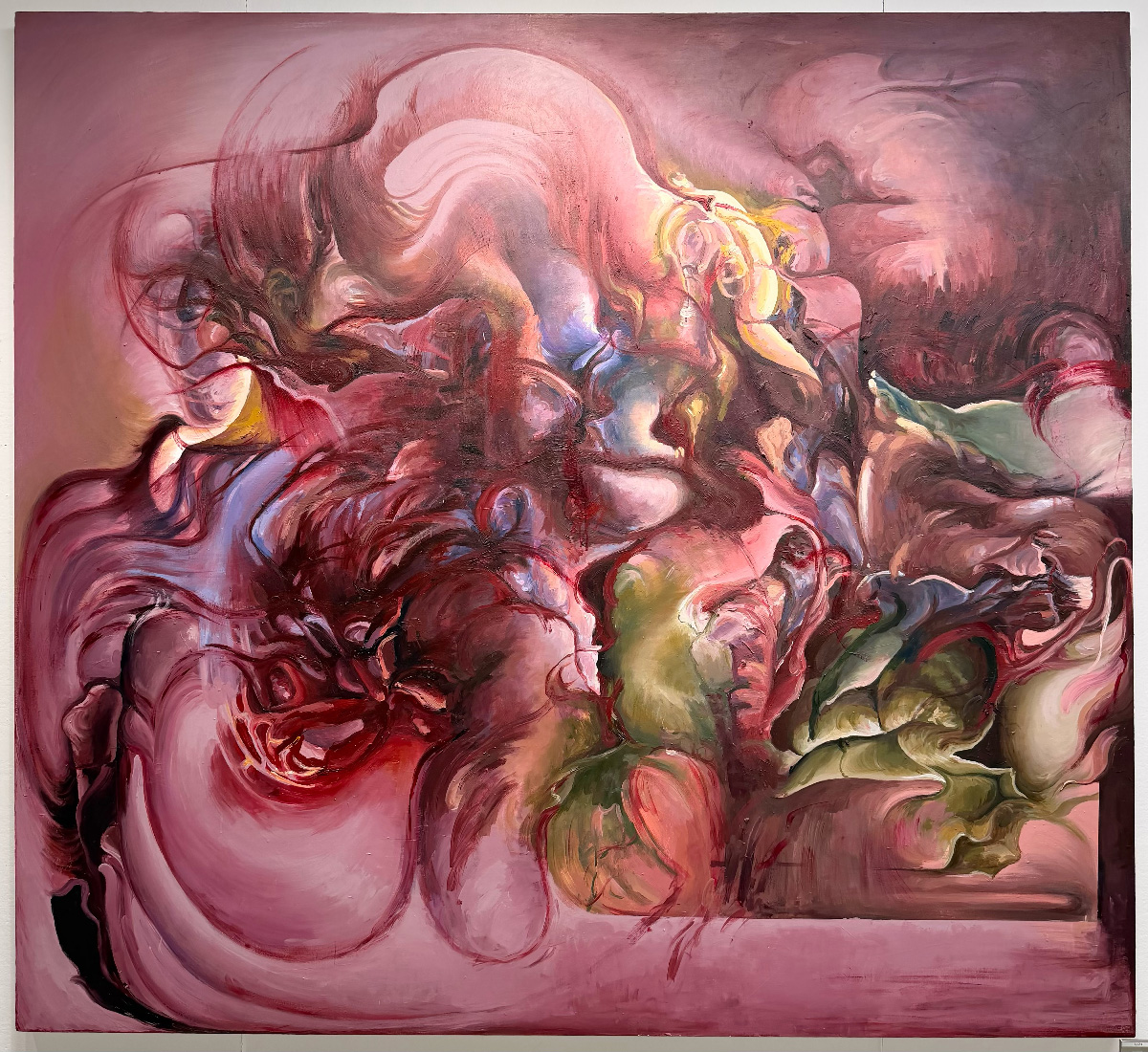
Where Olaoye’s practice mirrors the ruptured cocoons, wombs, and innards of his paintings, it appears as a chrysalis breaking open. It is no accident then, that a literal chrysalis appears miscegenated like Surrealist cake batter into one of his paintings, sharing existential space with adjacent moments of transformative becoming that burst open, as paint, all around it. The difference and repetition that comes to life in the paintings echoes the thought of Gilles Deleuze, a thinker from whom the artist has drawn inspiration alongside the post-humanist writings of Donna Harraway, whose discussions of limitless bodily plasticity and existential change are proximal to the exhibition’s questions of transformation and becoming.
If there is a word to end on with respect to Olaoye’s exhibition, it is cycling. Cycles of life, cycles of experience, cycles of thought and gesture, cycles of being and dying—these are the ascending and descending spirals hinted at in the exhibition’s title. But the title is also a bit of a trick, a prelude that hides its own truth openly on its face, in order that the viewer should have to discover the ruse on their own. The title suggests that “in another life” it is the case that “decay is a seed”. But decay is always already a seed in every life, in this life, in our life, just as it is in the life and death of the banana plant, or the mushroom. From the first moment of the exhibition, from the title, we are being drawn in as gently as possible to the improbable and sometimes frightening truth that life is death and death is life. And yet, the paintings also signal, through the beauty of their ephemeral organicism, that the subjective, experiential threshold between life and death, the gap that opens up the breathable space of our living experience, is also as wide and limitless as eternity.