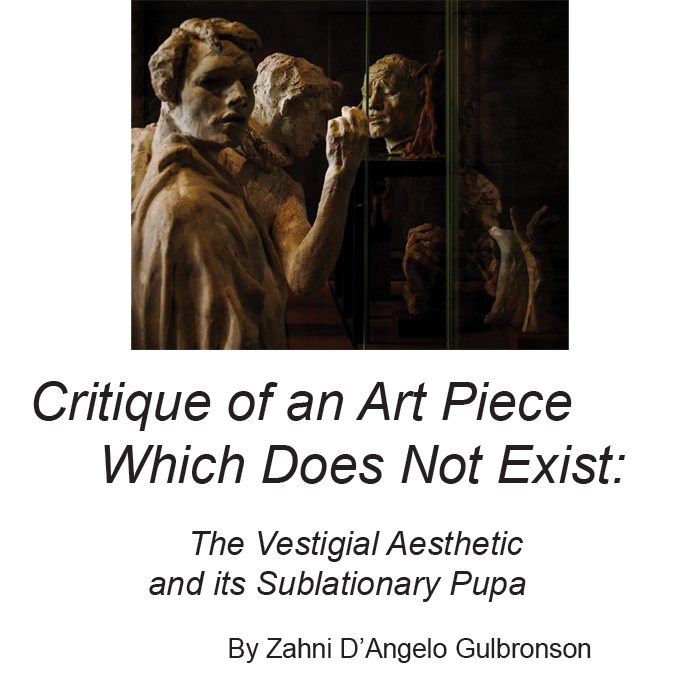
When scouring the vast, sterile wall of unadorned and untitled diptychs comprising The Vestigial Aesthetic and its Sublationary Pupa for the faintest trace of intoxication – a wall perhaps fittingly alcoved between the museum’s indoor, post-conceptual sculpture garden, and its retrospective gallery of early 2000’s process oriented abstraction – one can come to no other conclusion than that the contemporary artist, as truth’s supposed champion, in the past half century has not only failed to open hearts to her, failed to unveil her via intellect, but has instead gone so far as to misrecognize their failed attempts at said intellectual unveiling, as successful bids at opening hearts. Fortunately for my neophilic desire as a critic, and yours as a reader, that your attention to art critique will result in something greater than cultural literacy of a perpetually illiterate culture, ever expanding through time without maturation, the artist behind Vestigial Aesthetic seems to be just as privy to art’s current delusion as you or I, and knowingly or unknowingly offers himself up in martyrdom, much like the Israelites who wandered the desert for forty years, to be the last of his kind: one forced by formal/aesthetic impulse to be an artist.
One could, by technical definition, describe Vestigial Aesthetic as a photography installation, in that the images on the left side of each diptych (the “aesthetic” component of the piece, if you will) are comprised entirely from the visual information of a photograph identical in size and proportion, only each pixel is rearranged, some painstakingly by hand, others through an automatic algorithmic processor (the effect of the two being more or less indistinguishable from one another), such that the general composition, texture, and color of the original photograph is more or less preserved, while at the same time, pushing would be recognizable forms and subjects into almost complete abstraction. I was able to recognize a few of the compositions as being derived from well established, preexisting fine art photographs (most humorously, Andreas Gursky’s 99 Cent, which, despite its processing underwent almost no change at all), although others looked vaguely journalistic in nature, while more seem to have been shot for this installation specifically. To the right of each composition is an identical frame, instead filled with a block of text, describing in rote language, the contents of each original photograph, beginning with the subjects in frame and their dynamics with each other, followed by the broader sociopolitical or conceptual themes expressed through these dynamics, before listing smaller and smaller visual details beneath, filling the remainder of the frame. In short, Vestigial Aesthetic takes upon itself the task of distilling the sensuous, and the conceptual components of a photographic image; its pure aesthetic form, and its linguistically describable components, and holds them up, side by side for scientific examination.
Had the piece been titled differently, one could strain to see the work’s deconstructive character as an attempt to affirm the necessity of sensual-conceptual union; each component shown impotent in isolation yet yearning to be made whole such that the empty sensory stimuli of the former instills the latter with seductive power and the latter grants the viewer a lens with which to emotionally comprehend the former––a thesis that, when expanded to its medium at large, or to art as a whole, would do little more than didactically justify the status quo, engaging in the willful fantasy that art in its current form remains capable of the social power it held in centuries past, yet what we are given instead problematizes any positive assumption––its diagnostic centering the increasing irrelevance of the experiential in the construction and interpretation of artworks. Once understood to be the basis upon which art separated itself from other human disciplines––Hegel, for instance, noting that the “arousing of all feelings in us, [the] drawing of the heart through all the circumstances of life, [the] actualizing of all these inner movements by means of a purely deceptive externally presented object is above all what is regarded as the proper and supreme power of art”––the ubiquitization of conceptualism across art has relegated the aesthetic to a secondary role (Hegel 66). In the most fortunate of cases, a piece’s formal components may remain essential to its comprehension, but only insofar as they can be codified externally and placed into conceptual schema, yet more often are either simply the uncurated result of a concept’s physical realization, or worse still more or less cynically irrelevant aesthetic packages, serving to launder trite, underdeveloped, or simply uncompelling theses through the facilitation of momentary sensory intrigue. The latter cases may be simply written away as poor works of art, but it is the engagement with the former that more clearly reveals itself to function less like an artistic experience, and closer instead to Hegel’s description of a scientific one:
“Of course science can start from the sensuous in its individuality and possess an idea of how this individual thing comes to be there in its individual colour, shape, size, etc. Yet in that case this isolated sensuous thing has as such no further bearing on the spirit, inasmuch as intelligence goes straight for the universal, the law, the thought and concept of the object.” (Hegel, 57).
Upon dissection, the photographs in Vestigial Aesthetic appear to lose their artistic essence, yet maybe it only appeared to exist in the first place. If the color, composition, and texture of a photograph evoke nothing in of themselves, and a sensual engagement with them in conjunction with their corresponding content fails to enhance the conceptual bounds of the latter, then perhaps when we look at said photograph, or any artwork of that character, we are not seeing art at all but a mirage concealing something entirely different.
The peculiar position the artist behind Vestigial Aesthetic occupies in regards to their own critical inquiry is perhaps where the piece begins to fail, yet it is precisely in this failure that its true potential becomes apparent. Taken as is, Vestigial Aesthetic condemns the tyranny of the concept over the aesthetic, but hypocritically in that its own construction forgoes the integration of its aesthetic components into its conceptual foundation. Its deliberately monotonous format prevents its form from developing a sensuousness that could organically produce reflection independent from that which is described conceptually, and so one does not actually need to experience the piece in order to grasp its thesis. If the artist wished to combat the growing tide of aesthetic obliteration, they could simply create art in accordance with classic bourgeois ideals, “cherishing an interest in the object in its individual existence” rather than “struggling to change it into its universal thought and concept” but they are instead clearly attracted to the didactic aspect of the “nonartistic” art that they deride (Hegel 57). This is understandable– even justified given the seeming historical necessity of this type of art in the wake of rapid kitchification befalling more aesthetically focused modes of creation, but the question still remains what result one is searching for upon creating a piece that denounces the mode in which it operates. Perhaps the malignance of conceptually derived form-production comes not from an inherent lack of value, but rather simply due to its location within the artistic sphere; its self-conceptualization as art ensuring constant adjacency between it and its aesthetically oriented counterpart (such to blend together in audience perception, guaranteeing widespread misrecognition of the latter for the former), all whilst hampering its own ability to jettison the now residual aesthetic dimension which stubbornly sticks to the sole of its shoe.
The liberation of what we may call “form-based concept generation” from the confines of artistic expectation and even physical existence could both fulfill and surpass the original aims of conceptual art, in the creation of a space for audiences to self-consciously apply scientific interpretive perceptions onto abstract and metaphorical objects of contemplation only conceivable through the result of art’s sublation, not even to mention the infinite possibilities that could arise in the creation of conceptual objects, unbound by the technical skill of their author, or even their ability to be physically created. Rather than distracting oneself with constructing these conceptual objects in three dimensional space, one can simply discuss their implications as if they already exist, whether it be the metaphorical significance of a ten mile wide steel sculpture held upright by a toothpick, the narrative connotations of a film made entirely from the type of partial images one sees when closing their eyes and imagining an object, or the sociopolitical commentary inherent to the creation of a portrait of the pope made entirely from condoms. The propagation of this new, post artistic discipline wouldn’t replace nor diminish the role of traditional art, instead renewing it with new responsibility to create works whose sensual experience is essential. Some artists may find that their aesthetic impulses are filled simply by creating objects of aesthetic discussion, and those who do will need to generate conceptual forms that captivate without the crutch of tangible sensory stimulation. If the role of the artist is “to sustain the critical moment of aesthetic experience”, – a Sisyphean struggle to combat the reification of the potentially transformative into merely the pleasant, the work of the form-based concept generator will be the attempt to transform the mere interesting into the transformative (Buck-Morss 1). We can thank the artist behind Vestigial Aesthetic for the conceptual form that brought to light the necessity of this proposition, but we, as potential form-based concept generators ourselves, must take heed and create a new type of cultural environment, such that their next conceptual formulation can be communicated with far less ink.
Works Cited
1. Georg Wilhelm Friedrich Hegel, and Thomas Malcolm Knox. Aesthetics : Lectures on Fine Art. Vol. 1 … Oxford Clarendon Press, 1998.
2. Friedrich Schiller. On the Aesthetic Education of Man. 1794. London, Penguin Classics, 2016.
3. Susan Buck-Morss et al. “Visual Culture Questionnaire.” October, vol. 77, 1996, p. 25,